It was past midnight in the frozen marshes of Italy. November 1796. The Battle of Arcole had just ended in a bloody, chaotic French victory, but the real war was still breathing down their necks. The Austrians were regrouping. The cold was a weapon of its own.
And Napoleon Bonaparte, the young general with the gaunt face and the burning ambition, was doing something his enemies would never believe: He was walking the picket lines alone.
No bodyguards. No drums. Just a grey coat and the quiet crunch of frost under his boots.
He was checking on his sentries—the last line between his sleeping army and an Austrian blade in the dark.
Then he found him.
A single soldier, slumped against a frozen embankment. His musket had fallen sideways. His chin was buried in his collar. His breath came in slow, shallow clouds.
Asleep.
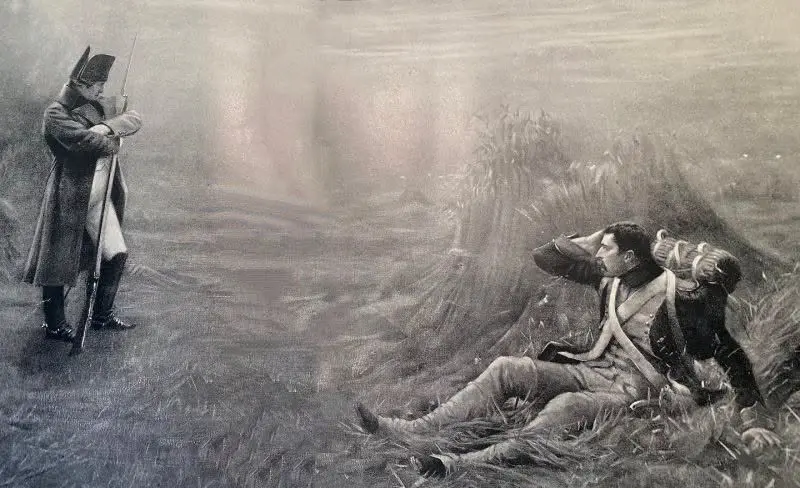
Under French military law, that was not a mistake. That was a death warrant. One word from Napoleon, and a firing squad would turn this exhausted boy into a cautionary tale by sunrise.
But Bonaparte did not shout. He did not draw his pistol.
Instead, he bent down. Silently. Deliberately. He pried the fallen musket from the soldier’s limp fingers.
And then—he took the man’s place.
For nearly two hours, the most feared general in Europe stood motionless in the freezing dark, long coat whipping in the wind, musket shouldered, eyes scanning the black horizon. A living statue. A ghost in a sentry box.
The soldier slept on, dreaming of home, unaware that his life was being held in the hands of a man who had just ordered the deaths of thousands.
Dawn crept in, pale and cruel.
The soldier stirred. Rubbed his eyes. And then his blood turned to ice.
The silhouette before him was not his comrade. The posture was wrong. The coat was wrong.
He blinked. Focused.
And saw the face—the pale skin, the sharp jaw, the eyes that had conquered half of Italy before the age of 27.
Napoleon.
The soldier scrambled to his feet, his throat closing. His hands trembled. He opened his mouth to beg, to explain, to weep—but no sound came. He knew the penalty. He had already imagined his own grave.
The general turned slowly. Handed back the musket.
Then, in a voice as calm as winter frost, Bonaparte said:
“Do not be afraid, my friend. After so much fatigue, a brave soldier may be forgiven for falling asleep. But another time, choose your moment better.”
No arrest. No chains. No firing squad.
Just a quiet warning—and a story that would echo through the barracks for generations.
Because here’s the terrifying truth behind the mercy: Napoleon knew exactly what he was doing. He wasn’t being kind. He was being strategic.
He had just fought a battle where his men had marched through mud and blood for 48 hours straight. They were broken. They were human. If he executed every exhausted sentry, he would have no army left. But if he showed restraint—if he stood guard himself—he would buy something far more valuable than discipline.
He would buy legend.
And that legend would spread faster than any court-martial. Men would whisper: “The general guarded a private. He bled with us. He froze with us.”
Loyalty, Napoleon knew, was not won with fear.
It was won with the unexpected.
So the question remains—was it mercy? Or was it the most brilliant propaganda of his career?
The sentry never slept on duty again. The army never forgot. And Napoleon? He walked away into the mist, a man who understood that sometimes, the deadliest weapon is not a cannon—but a gesture that no one saw coming.
The Austrians never knew. The historians still debate.
But that morning, in the frozen Italian dawn, one soldier learned a lesson he would carry to his grave:
When you serve a genius, even your failures become part of his plan.