The Ukrainian steppe. 1971. A bulldozer’s blade scrapes against dirt that hasn’t been touched in 23 centuries.
And then—the earth screams back.
Beneath the silent mound of Tovsta Mohyla, a team of archaeologists is about to rip open a grave that time itself had sealed. They expect bones. They expect rusted weapons. What they find instead makes their hearts stop:
2.5 pounds of solid, unblemished gold.
Not a coin. Not a crown. A pectoral—a ceremonial chest ornament so impossibly intricate that it feels like it was forged by gods, not men.
Dating to the 4th century BC, this is the treasure of the Scythians—the fierce, horse-riding nomads who terrified the ancient world and then vanished into the fog of history. They left no cities. No written records. Just burial mounds scattered across the Eurasian plains like scars on the earth.
And inside this one—Tovsta Mohyla—lay their ultimate secret.
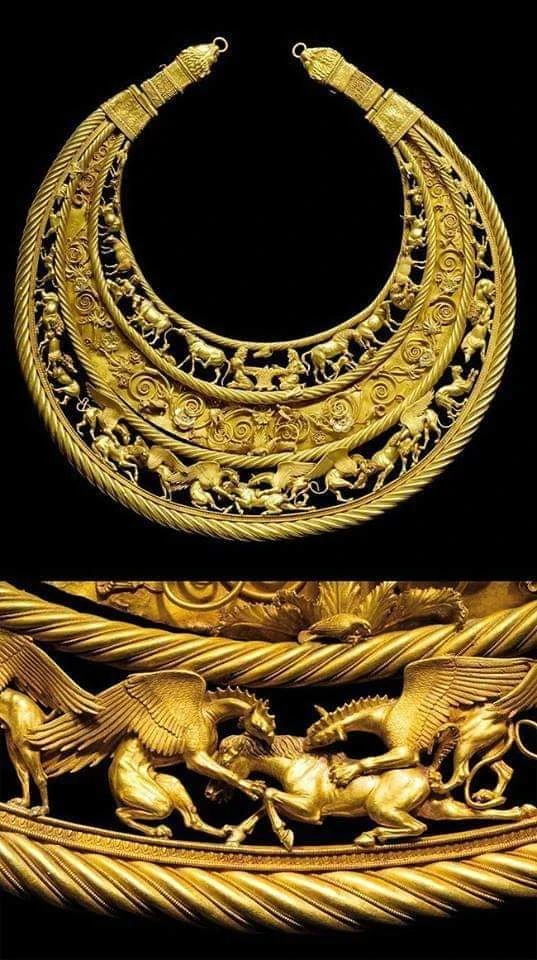
The gold itself is a frozen explosion of chaos. Three tiers of raw, violent life:
- In the bottom panel: wild beasts tear each other apart. A lion sinks its fangs into a stag. A griffin rips into a horse. Nature at its most brutal.
- In the middle: Scythian warriors in quiet, unnerving peace—stitching a garment, milking a ewe. The calm before the storm.
- In the top: mythical creatures that shouldn’t exist—half-eagle, half-lion—guardians of a world that no longer remembers their names.
But here’s where it gets strange.
The gold weighs over a kilogram. It’s perfectly preserved. Not a scratch. Not a dent.
As if it was placed there yesterday.
Who wore it? A king? A priest? A warrior-queen? The Scythians had women fighters—archaeologists have proven that. Could this have adorned a female ruler whose name has been erased from every history book?
And here’s the real mystery: Why was it buried at all?
The Scythians believed the afterlife was a mirror of this world. They buried their dead with horses, weapons, and enough gold to buy their way through the underworld. But this pectoral—this masterpiece—was not for trade. It was for power.
Some say it was a map of the cosmos. Others say it was a warning: We were here. We ruled. And we will return.
The archaeologists who uncovered it stood in stunned silence. The gold gleamed under the harsh Soviet sun—almost mocking them. 2,300 years underground, and it looked brand new. As if it had been waiting.
Today, it sits in a museum in Kyiv—a city now scarred by war, as if history refuses to let the Scythian spirit die.
But the questions linger, darker than the tomb they excavated:
Why was such a treasure left alone?
Why wasn’t it looted by the very enemies the Scythians fought?
And what else lies beneath Tovsta Mohyla—waiting for the next bulldozer, the next careless blade?
The Scythians left no books. No temples. No names.
But they left this—a golden scream across the centuries.
A whisper from the grave that says:
“We were here. We were magnificent. And you will never truly understand us.”
The pectoral remains silent.
But its secrets? They’re still buried in the dirt.
And someone, somewhere, is still digging.