A Cartoon Sailor With a Real Shadow
For nearly a century, Popeye the Sailor Man has lived in the imagination of millions.
He is the one-eyed sailor with massive forearms, a pipe in his mouth, a strange voice, a love for spinach, and an almost supernatural ability to survive any fight. To generations of children, he was simply a cartoon hero — funny, stubborn, loyal, and impossible to defeat.
But behind this exaggerated sailor may be something far more curious.
Long before Popeye became a global pop culture icon, there was a real man in a small American town whose face, habits, and reputation may have helped shape the character. His name was Frank “Rocky” Fiegel.
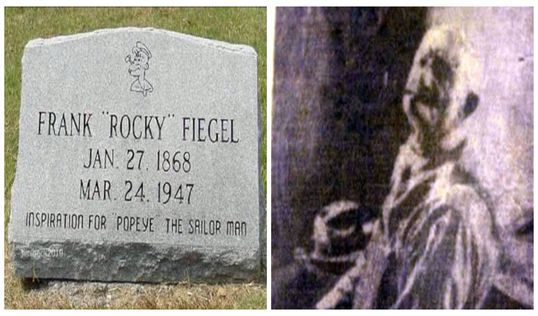
He was not famous in the usual sense. He was not a movie star, a politician, or a war hero. He was a rough local figure from Chester, Illinois — remembered for his pipe, his strength, his damaged eye, his fighting spirit, and his surprising kindness toward children.
In the world of Mysteries Beyond Earth, not every mystery comes from the sky. Some are hidden in ordinary streets, old towns, forgotten taverns, and the strange way real people become legends.
This is the story of the man behind Popeye.
The Birth of Popeye
Popeye first appeared in the comic strip Thimble Theatre in 1929, created by cartoonist Elzie Crisler Segar. At first, Popeye was not supposed to be the center of the story. He entered as a side character — a strange sailor with an attitude, a squint, and a voice that felt unlike anyone else on the page.
But readers immediately noticed him.
There was something magnetic about Popeye. He was not handsome. He was not polished. He was not the typical hero. He was rough, sarcastic, stubborn, and physically strange. Yet he also had a deep sense of loyalty and justice. He protected the people he loved, especially Olive Oyl, and he never stayed down for long.
Soon, the side character became the star.
What made Popeye unusual was not just his appearance. It was the feeling that he had stepped into the comic strip from somewhere real. He did not seem entirely invented. He seemed remembered.
And that may be because Segar had once known a man who looked and acted very much like him.
Frank “Rocky” Fiegel: The Man in the Legend
Frank “Rocky” Fiegel is often described as one of the real-life inspirations for Popeye. He lived in Chester, Illinois, the same town where E.C. Segar grew up.
Fiegel was known locally as a tough man. He reportedly worked around a tavern and became familiar to townspeople as someone who could handle himself in a fight. Stories about him describe a man with a pipe in his mouth, a strong jaw, muscular arms, and one damaged or unusual eye — details that sound strangely close to the cartoon sailor who would later become famous around the world.
But Fiegel was more than a local tough guy.
According to accounts connected to the Popeye legend, he had a softer side. Children were said to enjoy his stories. He reportedly entertained them with tales of his past, his strength, and his wild adventures. Like many figures who become folklore, he seems to have been both intimidating and oddly beloved.
That contrast may be the key.
Popeye is funny because he looks rough, but he is loved because he has a heart. He can fight, but he also protects. He is strange, but he is sincere. He is not a perfect hero — he is a survivor.
And Frank Fiegel, if the stories are true, gave Segar a real human model for that kind of character.
A Face Too Strange to Forget
The most mysterious part of the Popeye story is how many details appear to echo Fiegel’s real appearance.
Popeye’s squinting eye.
His pipe.
His strong forearms.
His rough voice and sideways speech.
His reputation as a fighter.
His strange mix of toughness and kindness.
These features are so distinctive that they feel less like random cartoon choices and more like memories transformed into ink.
Cartoonists often exaggerate the world around them. They take a gesture, a face, a walk, a voice, or a habit and stretch it into something unforgettable. A real person becomes a symbol. A local character becomes a legend. A man from a town becomes a sailor known across the planet.
That may be exactly what happened with Popeye.
E.C. Segar did not simply create a superhero. He created a working-class underdog who looked like he had survived life itself. Popeye’s strange face was not a flaw — it was the source of his power. He looked battered before the fight even began, which made every victory feel earned.
The Spinach Mystery
One of the most famous parts of the Popeye legend is spinach.
In the cartoons, spinach is almost magical. Popeye eats it, his strength explodes, and he becomes nearly unstoppable. For children, it was simple: spinach made Popeye strong.
But the real-world origin of that idea is more complicated.
The spinach element helped turn Popeye into more than a character. He became a symbol of sudden transformation — the weak becoming strong, the underestimated rising up, the impossible becoming possible.
That is why the spinach scenes worked so well. They were not just jokes. They were rituals.
A can opens.
The hero consumes it.
Power returns.
Justice arrives.
It is the structure of a myth, hidden inside a cartoon.
And like many myths, it grew larger than its creator could have imagined.
From Local Memory to Global Icon
Popeye’s success was extraordinary. After his comic strip debut, he moved into animated films, radio, television, merchandise, public statues, and eventually cinema. He became one of the most recognizable cartoon characters of the 20th century.
Yet his origin story still points back to something small and human.
A town.
A tavern.
A cartoonist.
A rough man with a pipe.
A childhood memory that refused to disappear.
This is what makes the story so fascinating. Popeye was not born only from imagination. He may have been born from observation — from the way Segar remembered the people around him.
In Chester, Illinois, ordinary residents reportedly inspired several characters from Segar’s world. That suggests Thimble Theatre was not just a comic strip. It was a strange mirror of a real community, transformed into fiction.
Real people entered the page in disguise.
And one of them became immortal.
Why Popeye Still Feels Different
Many cartoon heroes are designed to be admired. Popeye was designed to be recognized.
He is imperfect. He mumbles. He argues. He gets angry. He makes mistakes. He is not elegant, wealthy, or noble in the traditional sense. But he has something more powerful: endurance.
Popeye always comes back.
That may be why he survived across generations. He represents the stubborn part of human nature — the part that refuses to quit even when life has already landed too many punches.
If Frank Fiegel truly helped inspire him, then the mystery becomes even more powerful. A forgotten local man, remembered mostly through stories, may have unknowingly shaped one of the most enduring characters in global entertainment.
That is how legends work.
They do not always begin in palaces or battlefields. Sometimes they begin with one unusual person standing in the corner of a tavern, telling stories to children, unaware that one of those children may one day turn him into an icon.
The Hidden History Behind the Cartoon
The story of Popeye reminds us that popular culture often hides real human ghosts.
Behind a comic strip may be a childhood memory.
Behind a joke may be a local legend.
Behind a strange face may be someone who once walked real streets.
Behind a fictional sailor may be a man whose name almost vanished.
Frank “Rocky” Fiegel did not become famous in life the way Popeye became famous on screen. But if the stories are true, he left behind something stranger than fame.
He left behind an echo.
A distorted, exaggerated, immortal echo — wearing a sailor cap, smoking a pipe, eating spinach, and throwing punches at impossible odds.
The Final Mystery
Was Popeye directly based on Frank Fiegel in every detail? History leaves room for debate. The story is part documentation, part local memory, part folklore, and part pop culture legend.
But that uncertainty is exactly what makes it compelling.
Because somewhere between fact and myth, a real man seems to have crossed into fiction.
And once he entered fiction, he never left.
Popeye became more than a cartoon. He became a symbol of the underdog, the survivor, the rough-hearted protector who could be knocked down but never truly defeated.
Perhaps the greatest mystery is not whether Frank Fiegel inspired Popeye.
Perhaps the greater mystery is how an ordinary man can disappear from history — yet still live forever in the face of a cartoon sailor.