A House Built Like a Ship on Land
When most people imagine the Vikings, they picture longships cutting through dark seas, warriors landing on distant shores, and legends of gods, raids, and buried treasure. But the true heart of Viking life was not always found on the battlefield or at sea.
It was found inside the longhouse.
The Viking longhouse was more than a home. It was a shelter, a workplace, a meeting hall, a dining room, a bedroom, a storage space, and sometimes even a winter refuge for animals. In many ways, it was the center of an entire Norse world — a place where survival, family, status, belief, and mystery all burned around the same central fire.
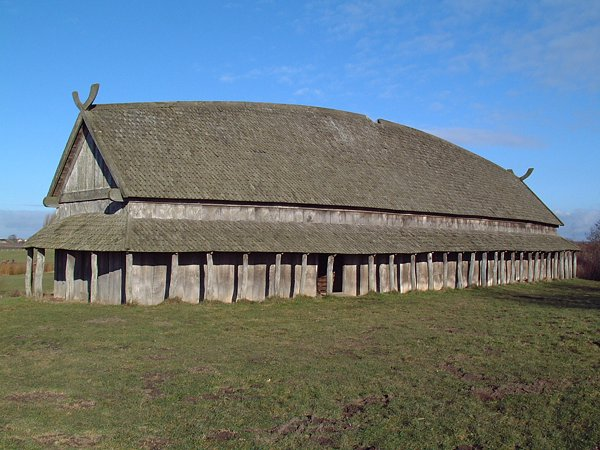
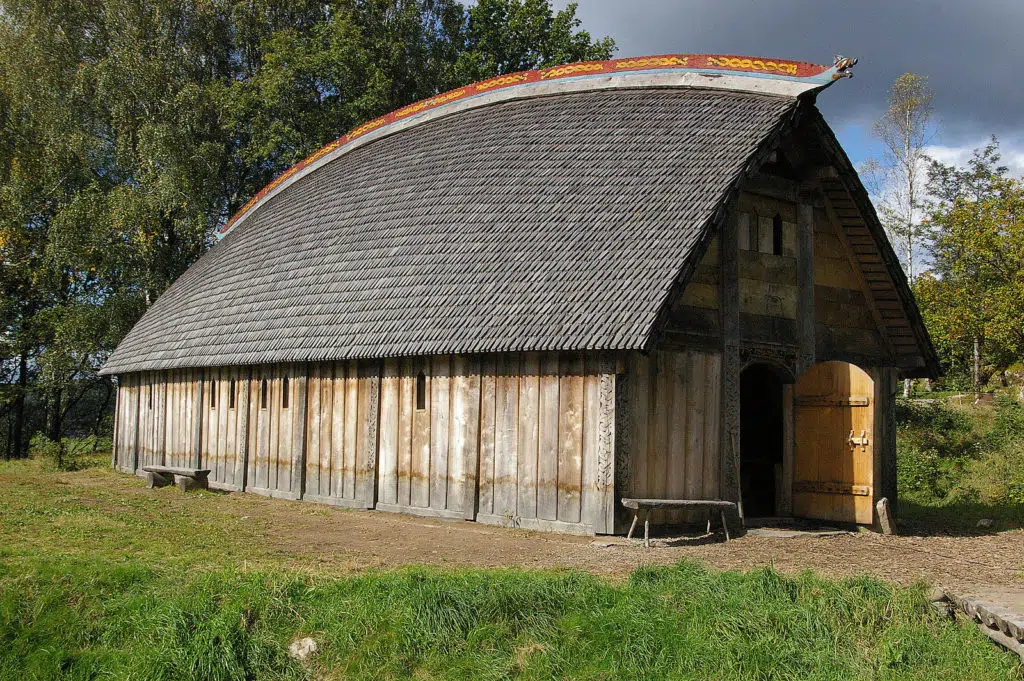
From the outside, these buildings could look almost like ships pulled onto land. Some had curved, bowing walls, giving them a long, vessel-like shape. That detail feels strangely fitting. The Vikings were people of the sea, but even their homes seemed to carry the memory of movement, voyage, and the unknown.
What Was a Viking Longhouse?
A Viking longhouse was a long, narrow building used throughout the Norse world during the Viking Age. Its size depended on the wealth and status of the people who lived there. A modest farming family might live in a smaller longhouse, while a powerful chieftain or wealthy landowner could command a much larger hall — one capable of hosting feasts, gatherings, and political alliances.
These homes were usually built from the materials available nearby. In forested regions, timber was common. In places where wood was scarce, people used turf, sod, clay, stone, or a combination of natural materials. The roof might be thatched or covered with wooden boards. Inside, strong posts helped support the structure, creating a long central space that could be divided into different areas.
But what made the longhouse remarkable was not only its architecture. It was the way one building could contain almost every part of daily life.
Inside the Smoke-Filled Hall
Step inside a Viking longhouse, and the first thing you might notice would not be decoration.
It would be smoke.
The central hearth was the living heart of the home. It provided heat, light, and a place to cook. During the cold months, the fire may have burned or smoldered for long periods, keeping the household alive through harsh northern weather.
But these homes usually had no modern chimney and few, if any, windows. Smoke escaped through an opening in the roof, but not perfectly. The air inside could be heavy, dark, and stinging. For the people who lived there, the longhouse was warm and protective — but also smoky, crowded, and intense.
Along the walls were raised benches or platforms. These served many purposes. People sat on them during the day, slept on them at night, and used them as places for work, conversation, storytelling, and rest. The same space could shift from a family room to a sleeping area, from a workshop to a feast hall, depending on the hour and season.
Family, Animals, and Survival Under One Roof
To modern eyes, one of the strangest details of Viking longhouse life is that animals could sometimes share the same building as humans.
This was not a sign of disorder. It was survival.
In a cold climate, livestock were valuable. Cattle, sheep, goats, and other animals represented food, wealth, labor, milk, wool, and status. Keeping animals protected through winter could mean the difference between survival and disaster.
Some longhouses had spaces at one end where animals were kept. Others had separate stables nearby. Either way, the Viking farm was not just a house — it was a system. The longhouse stood at the center of that system, surrounded by barns, workshops, storage areas, and fields.
Life was practical, physical, and demanding. Every corner of the farm had a purpose.
The Longhouse as a Place of Power
A Viking longhouse could reveal a great deal about a person’s rank.
For ordinary families, it was a place of daily work and survival. For powerful leaders, it could become something much greater — a hall of authority. Large longhouses were spaces where loyalty was built, disputes were settled, guests were honored, and alliances were strengthened over food and drink.
Feasting mattered deeply in Viking society. To host well was to show power. To feed guests was to display wealth. To gather warriors, neighbors, travelers, and kin under one roof was to shape reputation.
In a world without modern media, the longhouse was a stage. Stories were told there. Promises were made there. Marriages, funerals, seasonal celebrations, and political decisions could all pass through its smoky air.
The hall was not just where people lived.
It was where memory was created.
The Mystery of the Fire
Every ancient home has its shadows, but the Viking longhouse seems to hold more than most.
Imagine a winter night. Outside, the wind moves across frozen ground. Inside, the fire burns low. Smoke coils upward toward the roof. Children listen as elders speak of gods, monsters, voyages, omens, and the dead. Weapons hang near tools. Animals shift in the darkness. The boundary between daily life and myth feels thin.
This is where the longhouse becomes more than archaeology.
It becomes atmosphere.
The Vikings lived in a world filled with signs and stories. Their myths spoke of Odin, Thor, Freyja, giants, spirits, fate, and the end of the world. While not every longhouse was a sacred place, it was certainly a place where belief lived close to everyday life.
The same fire that cooked the evening meal may also have lit the faces of storytellers speaking of Valhalla, sea monsters, distant lands, and strange forces beyond human control.
For a site like Mysteries Beyond Earth, the Viking longhouse reminds us that mystery is not always found in the sky. Sometimes it is buried in the architecture of the past — in the way people built, gathered, feared, believed, and survived.
A World Without Privacy
Modern people often imagine home as a private space. The Viking longhouse was different.
Privacy was limited. Several generations might live together. Servants, workers, guests, children, and sometimes animals could all share the same structure. Life happened in public. Sleeping, eating, repairing tools, preparing food, weaving, telling stories, negotiating, and raising children all took place within the same smoky envelope of wood, earth, and fire.
This closeness created strong social bonds, but it also meant constant observation. Everyone knew everyone’s business. Every action mattered. Reputation was not an abstract idea — it was something shaped daily in front of the household.
In that sense, the longhouse was both home and witness.
Why the Viking Longhouse Still Fascinates Us
The longhouse survives in our imagination because it feels both familiar and alien.
It was a family home, yet also a fortress against winter. It was a farm building, yet also a political chamber. It was simple in materials, yet complex in meaning. It was a place of warmth, but also smoke. A place of community, but little privacy. A place rooted in earth, but shaped like a ship.
Perhaps that is why it continues to fascinate us.
The Viking longhouse was not just where Norse people escaped the cold. It was where they prepared for voyages, remembered the dead, protected their animals, raised their children, entertained strangers, honored leaders, and carried stories from one generation to the next.
Long after the fires went out, the shape of the longhouse remains — in archaeology, in reconstruction, in saga-like imagination, and in the human desire to understand how ancient people saw their world.
The Final Secret of the Longhouse
If the Viking ship was the symbol of movement, the Viking longhouse was the symbol of belonging.
One carried people across unknown seas. The other held them together when the world outside turned dark. And perhaps that is the greatest mystery of all: not how the Vikings conquered distant lands, but how they survived the long winters, the smoke, the hunger, the fear, and the endless uncertainty of a world they believed was watched by gods and haunted by fate. The Viking longhouse was not merely a building. It was a universe under one roof.