What if UFO propulsion does not depend on conventional engines at all, but on an element capable of manipulating gravity and even distorting spacetime? That extraordinary idea comes from Bob Lazar, the controversial figure who claims he once worked at the secretive S-4 facility near Area 51.
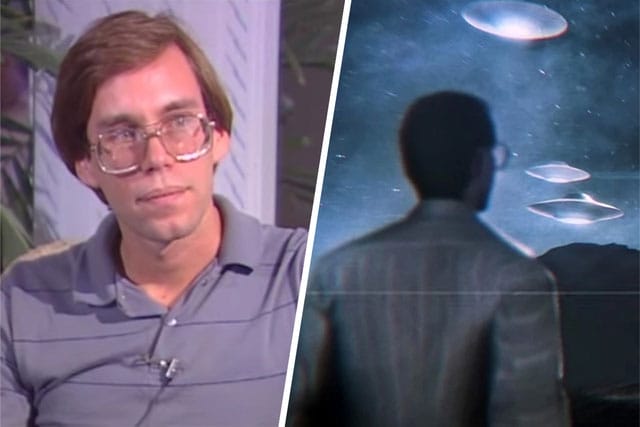
Lazar said that during his alleged work at S-4, he encountered documents describing research into a “gravity reactor” designed for propulsion. He also claimed to have seen nine flying saucers that were said to be of extraterrestrial origin, with an unknown element later identified in his account as element 115 serving as their power source.
According to Lazar’s explanation, the process began when protons were accelerated into element 115. He claimed this would transform it into element 116, which would rapidly break down and release enormous amounts of energy. In his account, that energy could amplify a nuclear force field and distort the surrounding space and time.
The result, Lazar suggested, would be something resembling a “warp bubble.” Instead of simply pushing a spacecraft forward through space, the system would manipulate spacetime itself, effectively shortening the distance the craft had to travel. The concept bears a resemblance to the warp-drive idea proposed by physicist Miguel Alcubierre in 1994.
There is, however, a major complication. Element 115 was eventually produced by scientists in Russia and officially added to the periodic table in 2013, under the name moscovium. But the known element does not behave like the material described by Lazar: it is highly unstable, has a half-life of less than a second, and has no demonstrated practical use as an extraterrestrial power source.
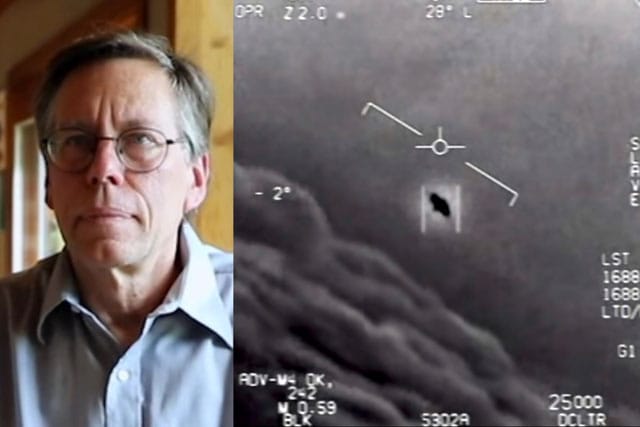
That difference is central to the controversy. The discovery of moscovium did not confirm Lazar’s claims, even though some UFO enthusiasts interpreted the existence of element 115 as evidence that part of his story had eventually been validated. Later documentaries and renewed attention to UFO investigations kept the debate alive.
For now, Lazar’s propulsion theory remains a remarkable claim rather than an established technology. The intriguing part is not that science has confirmed his flying-saucer engine, but that his story places a real chemical element at the center of one of the enduring mysteries surrounding UFOs.