A Baby Dinosaur Frozen Before Its First Breath
It never hatched.
It never walked the Earth.
But after more than 66 million years, this tiny creature may have revealed one of the greatest secrets linking dinosaurs to modern birds.
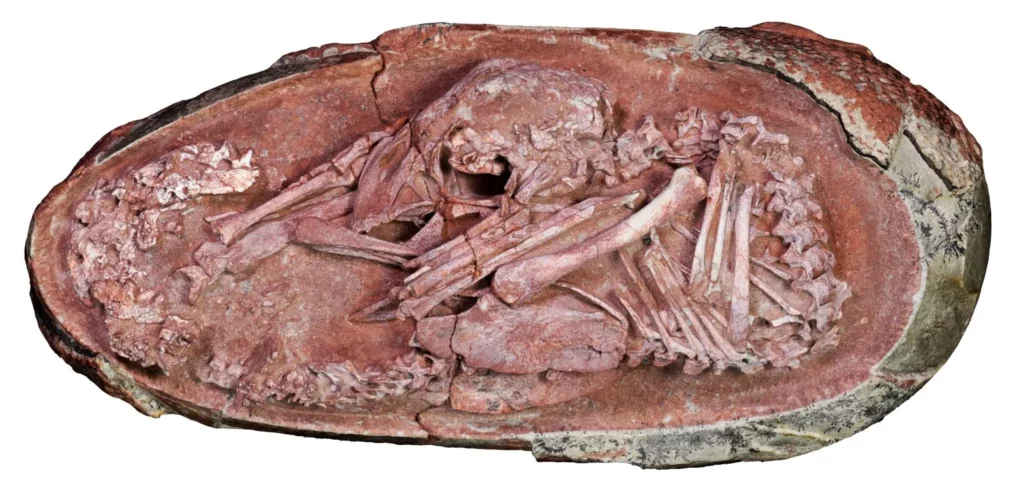
Inside a fossilized egg from southern China, scientists found an almost complete dinosaur embryo curled in a position that looked strangely familiar — not like a monster from a lost world, but like a baby bird preparing to break out of its shell.
They called it Baby Yingliang.
And its discovery changed how scientists think about dinosaur birth, evolution, and the hidden behaviors that may have survived into the birds we see today.
The Forgotten Egg in Storage
The story of Baby Yingliang began not in a dramatic desert dig, but in storage.
A group of fossilized dinosaur eggs had been acquired in China and later kept away for years. During work connected to the Yingliang Stone Nature History Museum, staff examined the old collection again.
One broken egg revealed something extraordinary.
Inside was a curled skeleton, preserved in remarkable detail. The bones had not been scattered beyond recognition. The embryo still lay inside the egg in a natural position, as if time had stopped just before birth.
For paleontologists, this was incredibly rare. Dinosaur eggs are common compared with complete embryos, but embryos are fragile. Their tiny bones are easily crushed, moved, or destroyed before fossilization can protect them.
Baby Yingliang was different.
What Kind of Dinosaur Was It?
Baby Yingliang belonged to a group called oviraptorosaurs — bird-like theropod dinosaurs that lived during the Late Cretaceous period.
These dinosaurs were not the giant, roaring predators people often imagine. Oviraptorosaurs were feathered, beaked, and closely connected to the evolutionary story of birds.
The fossil egg was about 17 centimeters long, while the curled embryo inside measured roughly 27 centimeters from head to tail. Scientists believe it was a late-stage embryo, meaning it may have been close to hatching when it was buried.
That is what makes the fossil so haunting.
This was not just an egg.
It was a life interrupted at the edge of birth.
The Strange Bird-Like Posture
The most important detail was not simply that Baby Yingliang was preserved.
It was how it was positioned.
The embryo’s head lay below its body. Its feet were tucked on either side. Its back curved along the blunt end of the egg. This posture looked strikingly similar to the “tucking” position seen in modern bird embryos shortly before hatching.
In birds, this position matters. Proper tucking helps the chick break out of the egg successfully. If the embryo fails to move into the correct posture, hatching can become dangerous or impossible.
Before Baby Yingliang, scientists had not clearly recognized this bird-like pre-hatching posture in non-avian dinosaurs.
That made the fossil more than beautiful.
It became evidence of behavior.
A Secret Passed From Dinosaurs to Birds
Baby Yingliang suggests that some behaviors we associate with birds may have begun much earlier — deep in the dinosaur family tree.
This does not mean birds are “like” dinosaurs in a loose way.
Modern birds are living dinosaurs, descended from theropod ancestors. Baby Yingliang gives scientists a rare window into that connection, not through teeth or feathers, but through the position of an unborn body inside an egg.
The fossil hints that the ancient choreography of hatching — curling, tucking, preparing to break through the shell — may have existed before true modern birds appeared.
That is the power of this discovery.
It shows evolution not only in bones, but in behavior.
Why This Fossil Feels So Unusual
Most dinosaur fossils show death after life.
Baby Yingliang shows life before birth.
There is no battle scene. No predator. No dramatic chase. Just a small creature curled inside its shell, preserved so delicately that it feels almost impossible.
It is a fossil that makes the prehistoric world feel intimate.
Dinosaurs were not only giants shaking the ground. They were also embryos inside eggs, parents guarding nests, bodies growing, instincts forming, and life waiting for the right moment to begin.
Baby Yingliang brings the ancient world closer because it shows something universal:
Before the roar, there was the egg.
The Mystery Still Inside the Stone
Even with this extraordinary discovery, many questions remain.
How common was this tucking behavior among dinosaurs?
Did all oviraptorosaurs hatch this way?
Did other theropods use similar movements before birth?
How much of modern bird behavior was inherited from dinosaur ancestors?
Scientists still need more fossils, more scans, and more comparisons.
Baby Yingliang is not the final answer.
It is a doorway.
The Final Secret of Baby Yingliang
A fossil egg sat forgotten for years.
Inside was a dinosaur that never hatched — but still carried a message across deep time.
Baby Yingliang tells us that the line between dinosaurs and birds is not just written in skeletons. It may also be written in posture, instinct, and the silent movements of life before birth.
For Mysteries Beyond Earth, this is the kind of discovery that changes the way we look at the past.
Because sometimes the greatest prehistoric mystery is not a giant footprint or a terrifying skull.
Sometimes it is a tiny body, curled in darkness, waiting to be born for 66 million years.