A Dark Road. A Wolf-Like Shape. A Legend That Would Not Stay Buried.
A quiet country road in Wisconsin became the center of one of America’s strangest cryptid stories.
Drivers said they saw something crouched by the roadside.
Witnesses described glowing eyes, long claws, gray-brown fur, and a wolf-like head on a body that could move like a man.
Some said it ran on two legs.
Others said it fed on roadkill, chased deer, scratched cars, and vanished into cornfields before anyone could explain what they had seen.
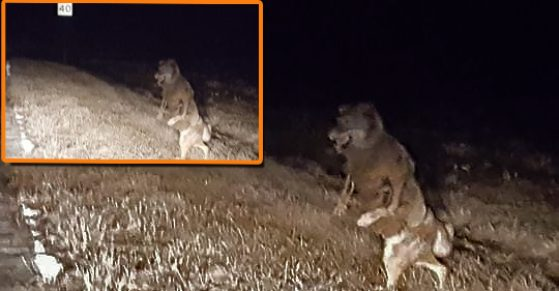
They called it The Beast of Bray Road.
And decades later, the question remains: was it a wolf, a bear, a hoax, a mass panic — or something that should not exist?
Where the Legend Began
Bray Road is a rural road near Elkhorn, Wisconsin. On most days, it looks ordinary: farms, fields, trees, quiet bends, and long stretches of pavement.
But in local folklore, it became something else — a place where the normal world seemed to crack open after dark.
Stories of a strange wolf-like creature in the area go back decades, but the legend exploded in the late 1980s and early 1990s. That was when multiple witnesses began reporting similar encounters around Elkhorn and nearby rural roads.
The descriptions were not always identical, but they shared disturbing details: a large hairy body, pointed ears, a canine face, unusual strength, and the ability to stand or move upright.
It was not simply “a big dog.”
At least, not to the people who claimed they saw it.
The Roadside Encounter That Made People Listen
One of the most chilling accounts involved a woman driving on Bray Road at night.
She saw something near the road, crouched or kneeling as if feeding. When her headlights hit it, the creature did not run away like a normal animal. It turned and looked at her.
She described long claws, large teeth, pointed ears, brownish-gray fur, and a posture that looked disturbingly human.
Another witness claimed she struck something with her car, stopped to check, and then saw a large hairy creature charging toward her. She escaped, but said the animal grabbed or struck the vehicle, leaving scratches behind.
Whether these stories were accurate, exaggerated, or misunderstood, they shared one powerful feature:
The witnesses sounded terrified.
The Reporter Who Took the Story Seriously
At first, the Beast of Bray Road sounded like a small-town rumor.
Then journalist Linda Godfrey began investigating.
Working for a local newspaper, Godfrey interviewed witnesses, gathered reports, and helped bring the legend to wider attention. She was not simply repeating campfire tales. She documented people who claimed they had seen something strange and were often reluctant to speak publicly because they feared ridicule.
Godfrey later wrote extensively about the case, helping turn the Beast of Bray Road into one of the most famous modern American cryptid legends.
Her work gave the story structure.
The witnesses gave it fear.
The road gave it a name.
What Did People Think They Saw?
The Beast has been described in several ways:
A wolf-like creature walking upright.
A large canine with human-like movement.
A “dogman” figure with claws and glowing eyes.
A huge animal crouched beside the road.
A creature moving between fields, woods, and farms.
Some reports suggest it was seen eating roadkill. Others connect it to missing animals, strange tracks, or livestock injuries.
But the most disturbing detail is always the same:
It was not just the size.
It was the posture.
Animals can look strange in headlights. Fear can distort memory. Fog, darkness, speed, and panic can turn ordinary wildlife into something monstrous.
But witnesses insisted this thing moved in a way that felt wrong.
The Rational Explanations
Not everyone believes the Beast of Bray Road is a monster.
Skeptics have offered several possible explanations:
A misidentified wolf.
A large dog.
A coyote seen in poor lighting.
A black bear with mange.
A hoax.
A case of local legend shaping what people thought they saw.
These explanations matter. Wisconsin has real wildlife, and animals can appear terrifying when seen at night, especially for only a few seconds.
A wolf or coyote lunging, standing, or moving through uneven ground could briefly appear upright. A sick bear or large dog could look unnatural. A frightened witness may remember details differently after the event.
But even with those possibilities, the legend survives because not all accounts are easily dismissed.
Too many people described something similar.
Too many seemed genuinely afraid.
Why Bray Road Became Famous
The Beast of Bray Road became more than a local monster story because it sits at the perfect intersection of fear and familiarity.
It is not a creature from a distant jungle or a lost mountain range.
It appears on a normal road.
Near farms.
Near homes.
Near headlights.
That is what makes it so effective as a legend. The setting is ordinary, which makes the story feel possible. Anyone who has driven alone down a dark rural road can understand the fear of seeing something in the ditch that does not move like it should.
The Beast became part werewolf, part dogman, part roadside ghost, and part American folklore.
Monster, Mirage, or Something Else?
The truth behind the Beast of Bray Road remains uncertain.
There is no confirmed body.
No verified DNA.
No clear photograph accepted as proof.
No scientific confirmation of a werewolf-like creature in Wisconsin.
But the mystery is not only about proof.
It is also about testimony.
Why did so many people report something wolf-like and upright? Why did the stories cluster around the same region? Why did the legend grow from local whispers into a nationally known cryptid case?
Maybe the Beast was never one creature.
Maybe it was a mix of real animals, fear, folklore, mistaken sightings, and a few genuinely strange encounters that still resist simple explanation.
That may be the most realistic answer.
And somehow, it is still unsettling.
Why the Beast Still Haunts the Imagination
The Beast of Bray Road endures because it touches an ancient fear: the fear that the wild is closer than we think.
A road is supposed to be safe.
A car is supposed to protect us.
Headlights are supposed to reveal the truth.
But in the Bray Road stories, the headlights do not solve the mystery.
They create it.
For Mysteries Beyond Earth, this legend belongs in the world of modern folklore — where witness reports, local fear, animal behavior, and the unknown collide.
The Beast may be a misidentified animal.
It may be a legend that grew too large.
Or it may be one of those rare stories where something truly strange crossed the road and disappeared before the world could catch up.
The Final Mystery
The most frightening part of the Beast of Bray Road is not that people saw a monster.
It is that the road still exists.
The fields are still there.
The trees are still there.
And every night, headlights still pass through the same darkness where witnesses once claimed something looked back.
Maybe there is nothing there.
Maybe there never was.
But on a lonely Wisconsin road after midnight, that may not be enough to keep you from checking the ditch.

